Maersk's Singapore Mega-Warehouse and Thai Cargo
Maersk's new 1.1M sq ft automated World Gateway II in Singapore doubles regional warehousing — what this means for Thai exporters and SE Asia consolidators.
On 18 March 2026, A.P. Moller - Maersk officially opened World Gateway II in Singapore — a 1.1 million square foot, fully automated global and regional distribution centre backed by a S$200 million investment. The new facility sits a short distance from Maersk’s existing 1.0 million sq ft World Gateway, effectively doubling the carrier’s Singapore warehousing footprint overnight and marking one of the largest single additions of automated warehousing capacity in Southeast Asia this year.
For Thai exporters and SE Asia consolidators that route cargo through Singapore — and that’s a very large share of our book — this is more than a press release. It changes the economics of transshipment, the realistic lead time for B2C e-commerce fulfilment, and the options available to shippers that want bonded, GST-deferred warehousing close to a deep-water terminal. Below is the Polaris Line read on what matters.
What opened in Singapore, and why scale matters here
World Gateway II is not a conventional warehouse. The floor plate is configured for 11-metre clear height per floor, which is what allows the Multi-Shuttle System, Automated Storage and Retrieval System (ASRS), and Autonomous Case-handling Robots (ACR) to run dense vertical storage without sacrificing throughput. The building also carries LEED Platinum and Green Mark Platinum certifications and TAPA Class A security accreditation, which matters for high-value lanes — luxury fashion, electronics, pharma — where a buyer’s compliance desk asks about facility ratings before signing a contract.
The Singapore Government is backing the project publicly. The Maritime and Port Authority (MPA) framed World Gateway II as strengthening Singapore’s position as a premier logistics hub in APAC, and reports indicate the facility has already reached around 70 per cent occupancy and will create roughly 500 jobs once fully operational. That occupancy figure is the tell — commercially, the space has been pre-sold to shippers that want automated regional fulfilment before peak season, not speculative capacity.
Key numbers
- 1.1 million sq ft — total floor area of World Gateway II
- S$200 million — Maersk’s investment in the facility
- 16.8 km — distance to Tuas Mega Port
- 42.6 km — distance to Changi Airport
- ~500 jobs — once fully operational
- ~70 per cent — pre-opening occupancy
- 11 metres — clear height per floor
- Customs bonded, zero-GST warehouse status for non-dutiable goods
Why Singapore matters for Thai cargo
For cargo originating in Thailand, Singapore has long been the primary Southeast Asia transshipment hub — particularly for consolidated LCL cargo heading to the Middle East, Europe, and Oceania, and for air-freighted goods feeding intercontinental capacity out of Changi. When our desk books a Bangkok–Jebel Ali or Bangkok–Rotterdam lane for SME clients, the operational question is rarely whether to transit Singapore; it’s which terminal, which carrier window, and which consolidation point.
What World Gateway II changes is the warehousing leg of that journey. Until now, Thai exporters that wanted to hold stock in Singapore for B2C e-commerce fulfilment across the region — think Shopee Singapore, Lazada Malaysia, JD Indonesia, Gulf marketplaces — were bidding against luxury fashion, FMCG, and technology brands for scarce automated capacity. With roughly a million square feet of new bonded, automated space coming online, the queue gets shorter and the commercial terms improve. A Thai electronics brand that wants fulfilment into five regional marketplaces now has a more realistic shot at co-locating inventory in Singapore instead of spinning up separate country warehouses.
The customs bonded, zero-GST warehouse status is the quiet detail that matters most to small and mid-sized exporters. Import GST on non-dutiable goods is deferred until goods enter the market — so stock parked in Singapore for later onward fulfilment does not tie up working capital in tax paid before a sale ever happens. Combined with the transport-management integration, that makes Singapore a genuinely viable regional “hold and release” base, not just a pass-through.
What the automation actually changes
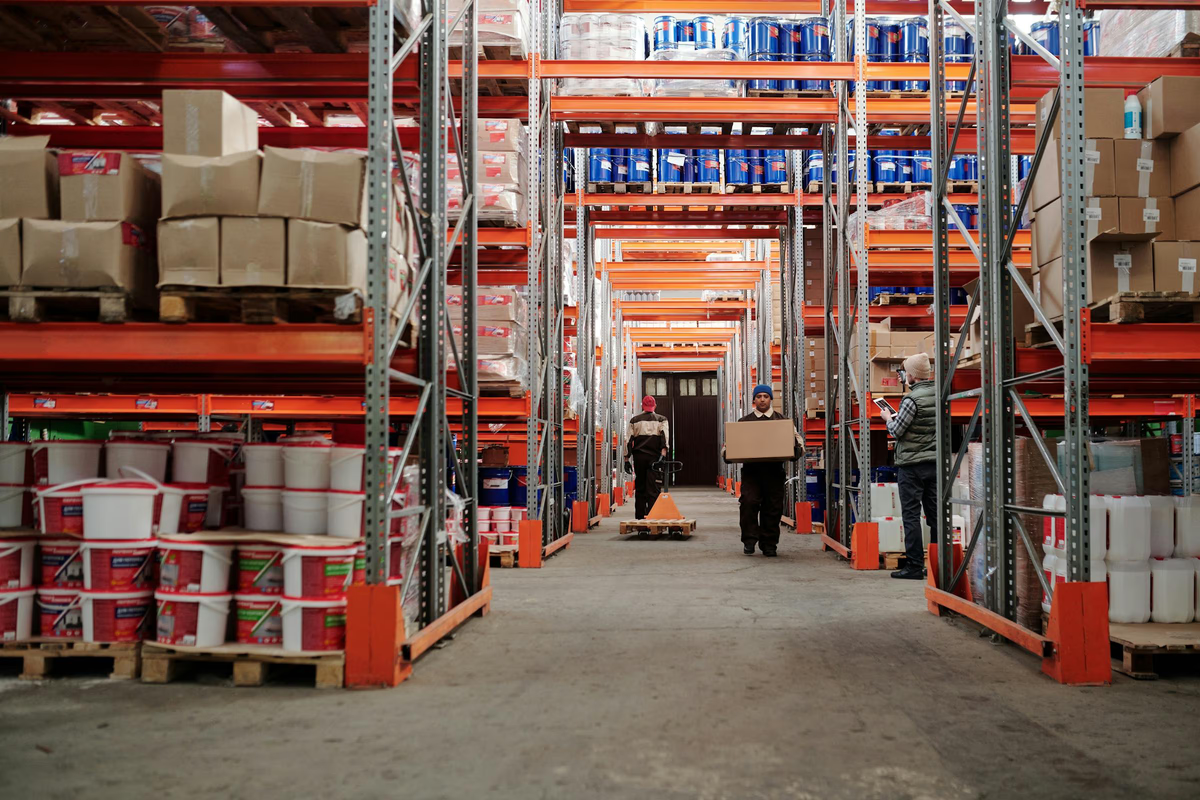
The three automation systems Maersk has deployed — Multi-Shuttle, Automated Storage and Retrieval (ASRS), and Autonomous Case-handling Robots (ACR) — translate to four concrete operational gains that a shipper can plan around:
1. Shorter order-to-dock lead times
Manual pick-pack at scale ties regional fulfilment to a six to eight hour window between order cut-off and dock-out. ACR-driven fulfilment collapses that window. For Thai consignors moving cargo through Singapore into regional marketplaces, the practical implication is that same-day onward dispatch becomes a realistic commitment on orders received before mid-afternoon Singapore time — something that was previously only possible for shippers willing to pay premium dedicated-warehouse rates.
2. Higher accuracy on mixed-SKU cargo
FMCG, wellness, and lifestyle shippers routinely run dozens of SKUs per consolidation. Automated pick accuracy above 99.9 per cent reduces returns, mis-shipments, and the expensive secondary handling that eats margin on low-ticket B2C orders. For Thai SME brands trying to crack regional marketplaces, fewer returns is a direct contribution to unit economics.
3. Better seasonal scalability
Rooftop container parking, ample loading bays, and the facility’s 11-metre floor height mean the site is engineered for peak-season surge without the usual bottleneck at the receiving dock. A Thai apparel brand sending extra inventory for Ramadan, Singles’ Day, or Lunar New Year can ramp volumes through World Gateway II without pre-booking months of dedicated dock capacity.
4. Compliance fit for high-value verticals
TAPA Class A, LEED Platinum, and the integrated WMS mean luxury and pharma-grade compliance is built into the facility rather than bolted on. For Thai exporters moving into high-value verticals — auto parts with supplier audit requirements, premium electronics, cosmeceuticals — that compliance scaffolding is often the difference between winning and losing a contract with a regional distributor.
How Polaris Line is responding
With our Bangkok headquarters and our Dubai partnership with Polaris Shipping Agencies LLC, we are actively adjusting our Singapore-transit playbook so that our clients capture the new capacity rather than watch it get booked out by larger brands:
- Singapore consolidation quoting — We are refreshing our Bangkok–Singapore LCL consolidation rates to make it economical for SME Thai exporters to route through Singapore for regional B2C fulfilment, not only for onward Gulf or Europe transit.
- Bonded-warehouse introductions — For clients that qualify for zero-GST bonded storage, our team is facilitating introductions and paperwork so stock can be positioned in Singapore while deferring import GST until the goods are actually sold downstream.
- Tuas Port routing advisories — World Gateway II’s 16.8 km proximity to Tuas Mega Port changes the cut-off math on Singapore-discharge bookings; we are flagging the new timing windows on every quote touching Tuas.
- Air-sea combinations via Changi — Where cargo needs to move from Thailand to final destination faster than ocean allows, we are pricing sea-Singapore-air combinations that stage at World Gateway II and uplift out of Changi, instead of defaulting to direct airfreight from Bangkok.
- Surge-window planning — Our operations desk is building peak-season Singapore dock slots into plans at the quote stage, so Thai apparel, FMCG, and electronics shippers hit Singles’ Day, Ramadan, and Q4 windows without last-minute capacity scrambles.
What Thai exporters should do this month
- Map your regional fulfilment flows — List every SE Asia destination your brand serves and identify which ones currently run from country-specific warehouses versus a regional hub. Singapore bonded storage is now realistic for multi-country plays.
- Request a Singapore-routed quote — If you are shipping Bangkok–Dubai, Bangkok–Rotterdam, or Bangkok–Jeddah, ask your forwarder for a Singapore-transit option and compare it against direct routings on cost, transit time, and flexibility.
- Check bonded-warehouse eligibility — For non-dutiable goods, zero-GST bonded status in Singapore is a cash-flow improvement. Verify with your customs adviser whether your product class qualifies.
- Audit your peak-season booking windows — World Gateway II improves surge capacity, but only for shippers that plan ahead. Lock seasonal dock slots now, not in October.
- Reassess your airfreight default — For time-sensitive SKUs, a sea-to-Singapore-then-Changi-air combination can beat direct Bangkok airfreight on both cost and reliability, especially on lanes affected by the current Middle East picture covered in our war-risk playbook.
Where this leaves your Singapore strategy
World Gateway II is a capacity announcement, but the deeper signal is Singapore’s continued positioning as the automated fulfilment backbone for Southeast Asia — with government backing, deep-water port proximity, and now a doubled Maersk footprint to match. For Thai exporters, the opportunity is not to ship more; it is to ship smarter through a hub that finally has the automation to handle SME-scale regional fulfilment without premium pricing. The window to lock favourable commercial terms is open while the capacity is fresh.
Contact our team to discuss how the Singapore capacity expansion affects your shipping schedule and whether a Singapore-transit or bonded-storage option fits your regional flow.