Red Sea Return: Suez Restart for Thai Exporters
Maersk's MECL and ME11 services are back on the trans-Suez route as Red Sea waters calm. Here's what the restart means for Thailand–Europe and Gulf freight.
On 16 February 2026, Maersk confirmed a structural return of its MECL and ME11 services to the trans-Suez route, reversing nearly two years of Cape of Good Hope diversions for a segment of its East–West network. The carrier’s message to customers: the Red Sea corridor is calming, but the rebalancing back to Suez will not be frictionless — expect port congestion, yard density, and schedule recovery issues through Q2.
For Thai and Southeast Asia exporters moving into Europe and the Mediterranean, this is the most consequential routing change of 2026 so far. Faster transit is within reach again — but only for shippers who plan the transition actively. Below is our read on what has shifted, where the friction sits, and how we are advising clients this month.
What Maersk has restored — and what it means for transit times
The MECL (Middle East, China, Latin America) and ME11 services are two of the East–West workhorses that got pushed onto the Cape route in 2024 when Red Sea attacks made Bab el-Mandeb transits unworkable for major carriers. The Cape diversion added roughly 10–14 days of sailing time and meaningful bunker cost to every rotation. A structural return to Suez recovers most of that transit time — but only once the fleet cadence stabilises.
Maersk’s framing matters here. They are not calling this a return to normal; they are calling it a structural return — meaning the routing decision is being baked back into the network plan rather than treated as an opportunistic test. That is a stronger signal than the one-off Suez runs we saw in late 2025, and it is why other carriers are watching closely before committing their own east-west strings back through Bab el-Mandeb.
Key numbers
- ~10–14 days: typical sailing time saved vs. Cape of Good Hope routing on the affected strings
- 2 services confirmed in the structural return: MECL and ME11
- 16 Feb 2026: the date Maersk formally communicated the change to customers
- ~20%: share of global fuel that moves through the Strait of Hormuz — a reminder the wider Gulf operating picture is still volatile even as Red Sea tensions ease
- 4–6 weeks: the window Maersk and peer carriers typically need to absorb a major routing shift before schedule reliability stabilises
Why the restart will not be frictionless
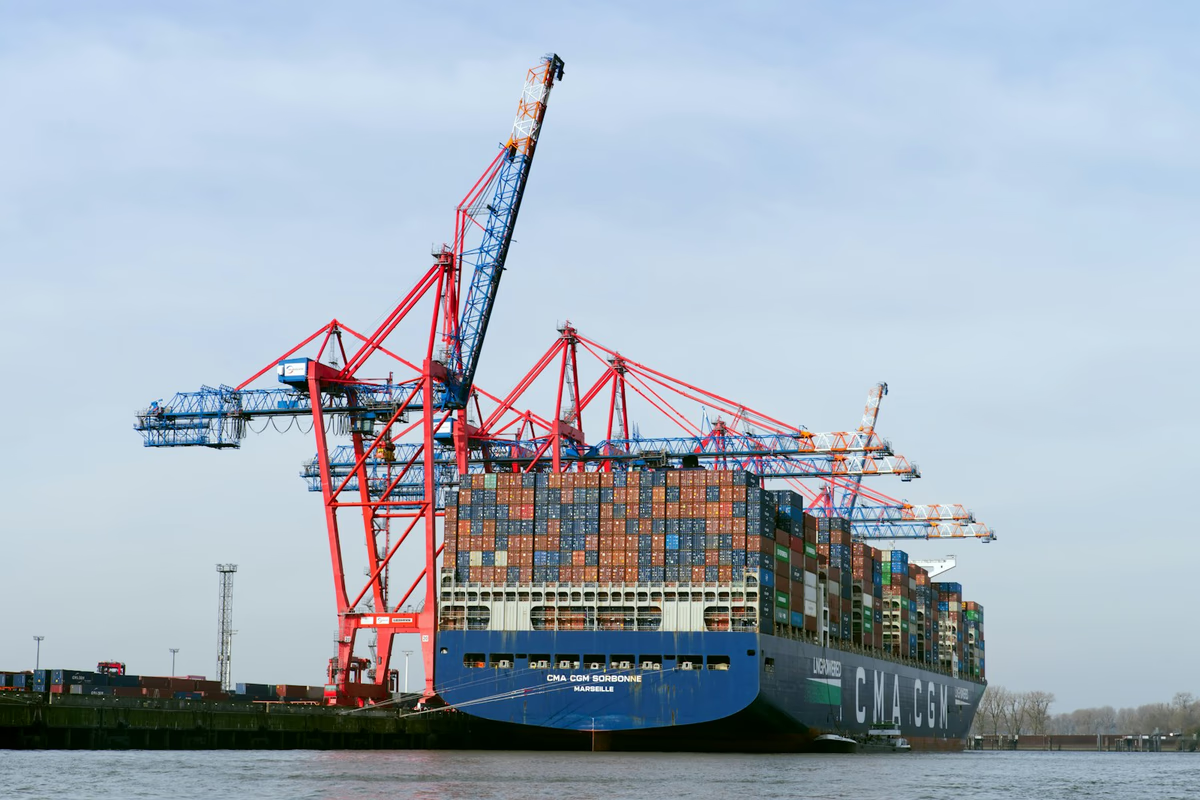
A shift from the Cape of Good Hope back to the trans-Suez route sounds like a clean win for transit time, but the operational reality is messier. Vessels arriving on the restored schedule will land at terminals that have been calibrated — for nearly two years — to a different cadence. Rotterdam and the Western Mediterranean entered April already carrying elevated yard density from winter storms and an uncharacteristically noisy European picture. Layering faster-arriving MECL and ME11 units on top of that risks a classic congestion pulse at gateway ports.
Maersk itself flagged this directly: customers should expect minor possible port backlogs and congestions as the rotation absorbs the change. For Thai shippers, that means the advertised transit saving does not fully translate into door-to-door savings until terminal side and inland haulage catch up. The first few rotations of any restored string typically run 48–72 hours slower than the published schedule — and slower yet if paperwork is not watertight at the gateway.
What this means for Thai exporters
The restart changes three things for shippers routing through or around the Gulf:
1. Transit windows on Asia–Europe legs should improve — but not immediately
Exporters who saw sailings rerouted around the Cape in 2024–2025 will start to see shorter schedules reappear on rate sheets over the next two to four weeks. Do not plan as if the savings are already in the booking — treat published schedules as targets for now and build 48–72 hours of buffer into the first Q2 sailings on restored strings. We are.
2. Asia–Gulf economics remain separately volatile
The Suez restart is a Red Sea story. The Strait of Hormuz situation remains its own chapter, and Bangkok–Jebel Ali and broader Thailand–Gulf freight continue to price off Hormuz risk rather than Red Sea calm. Do not let one normalising corridor mask the other that is still tight.
3. Surcharge structures will shift faster than contract rates
When a major carrier restores a routing, the first cost signals show up in surcharge adjustments — Bunker Adjustment Factor, Emergency Risk, and route-specific contingency fees — before base rates on long-term contracts move. Exporters on spot should start seeing downward pressure within weeks. Those on annual or quarterly contracts should ask their forwarders when the next rate review is scheduled and what their leverage looks like now that the operational premise has changed.
How Polaris Line is responding
With our Bangkok headquarters and our Dubai partnership with Polaris Shipping Agencies LLC, we are actively managing the transition for our clients on the Thailand–Europe and Thailand–Gulf lanes:
- Schedule verification — We are re-checking every Q2 sailing booked on affected Maersk strings against the newly published MECL and ME11 rotations, flagging any client exposure to first-wave schedule slippage before containers gate in
- Alternative carrier routing — For time-sensitive cargo, we continue to quote Evergreen, Hapag-Lloyd, and CMA CGM options alongside Maersk so our clients see the full landed-cost picture, not just the carrier with the loudest routing announcement
- Surcharge negotiation — Our long-standing carrier relationships let us challenge BAF and contingency line items that lag the operational reality; we flag every invoice where Cape-era surcharges have not yet been unwound
- Gateway-paperwork tightening — With congestion pulses expected at Rotterdam and Western Med gateways, we are reviewing transit documentation for every container destined to Europe or Balkan hinterlands to avoid the kind of late-paperwork holds that now draw EUR 65 documentation fees at Rijeka and similar charges elsewhere
What Thai exporters should do this month
- Audit your Q2 bookings on Maersk MECL and ME11 strings — verify published schedules against the new trans-Suez rotation and flag any sailings where the advertised transit is not matching the carrier’s own latest update
- Ask your forwarder when your next rate review is — if you are on a contract signed during the Cape-diversion period, the restart is material context for a constructive rate conversation
- Keep a 48–72 hour buffer on the first two sailings of any restored string, especially for cargo landing at Rotterdam or Western Med gateways that are already carrying yard density
- Tighten gateway documentation now — with European gateways under congestion stress, any late or incomplete transit paperwork will cost more than it did six months ago; our customs team can walk you through the checklist
- Do not conflate Red Sea calm with Gulf calm — Thailand–Jebel Ali and broader Hormuz-adjacent lanes are pricing off a separate risk picture and need their own routing review
Where this leaves the Asia–Europe lane
The return to Suez is real, but the savings are not yet in your inbox. Shippers who treat the first few weeks of restored rotations as target schedules rather than guaranteed ones — and who use the restart as a conversation starter for surcharge and rate reviews — will capture the economics of the structural return faster than those who wait for the carriers to hand it to them. Polaris Line’s posture for Q2 is active management of the transition, lane by lane, rather than assuming the network has already rebalanced.
Contact our team to discuss how the Red Sea restart affects your shipping schedule and rate review for the rest of the year.